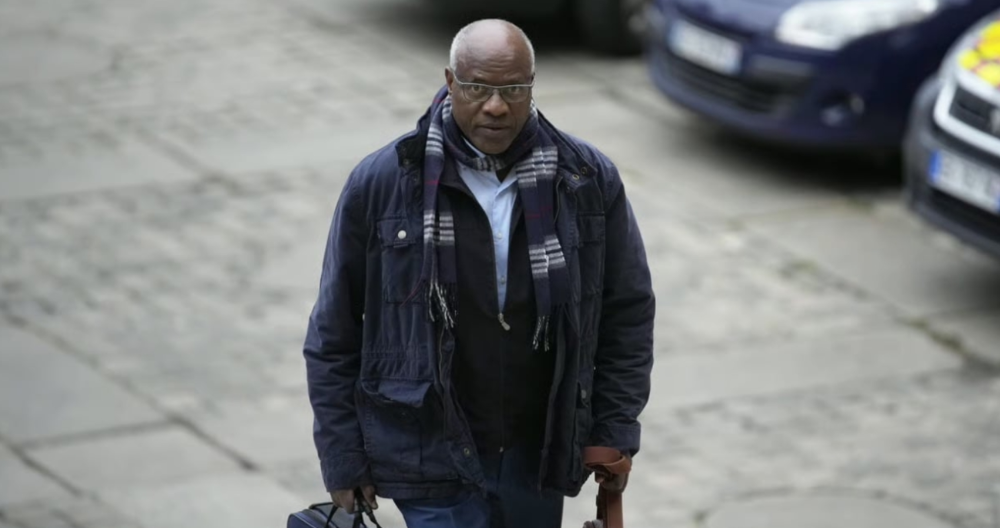
After nearly three decades of judicial pursuit, France has reaffirmed the conviction of Sosthène Munyemana, a former Rwandan gynaecologist and lecturer at the National University of Rwanda, for his role in the 1994 Genocide against the Tutsi.
Known infamously as the “Butcher of Tumba,” Munyemana’s 24-year prison sentence was upheld by the Paris Court of Appeal, bringing to a close one of the longest and most symbolically charged trials linked to Rwanda’s dark history.
The appeal hearings, which ran from September 16 to October 23 in Paris, revisited the harrowing events in the former Butare Prefecture, where Munyemana was accused of orchestrating massacres and detaining Tutsi civilians at the Tumba sector office before they were killed.
The verdict marked another milestone in France’s belated yet growing record of prosecuting genocide suspects who found refuge on its soil.

A doctor turned perpetrator
Born in 1955 in Musambira, now Kamonyi District, Munyemana trained as a medical doctor at the National University of Rwanda before specializing in gynaecology at the University of Bordeaux II in France.
When he returned home, he served at the University Teaching Hospital of Butare (CHUB) and lectured in the Faculty of Medicine, positions that placed him at the heart of Rwanda’s intellectual elite.
But when genocide erupted in April 1994, the man once trusted with saving lives was accused of taking part in their destruction. Witnesses told the court that Munyemana detained Tutsi civilians at the Tumba sector office, where they were later taken out to be killed.
Others said he participated in meetings that encouraged the extermination of Tutsi and personally supervised night patrols and checkpoints that targeted victims.
One survivor recounted how Munyemana, once seen as a respected community figure, turned into a man of influence in Tumba despite not holding an official position. His involvement was so notorious that he became known locally as the “Butcher of Tumba.”
After the genocide, Munyemana fled to France in 1995 and resumed his medical career in Bordeaux, later working at Villeneuve-sur-Lot Hospital. For years, he lived an ordinary life in Europe even as survivors and human-rights groups pressed for justice.
Rwanda issued an international arrest warrant in 2006, and Interpol placed him under a red notice, but extradition requests went unfulfilled. It was not until 2023 that the Paris Court of Assizes found him guilty of genocide, crimes against humanity, and complicity in genocide, sentencing him to 24 years in prison.
The case had taken 28 years, a span that underscored both the complexity of transnational justice and the resilience of those who refused to forget.

The appeal and the reckoning of history
Munyemana’s appeal trial, which opened in September 2025, offered yet another opportunity for France to confront its role in the Rwandan tragedy. Over 60 witnesses, including survivors, researchers, and experts were heard in the six-week proceedings.
Among them was Hélène Dumas, a French historian who has spent two decades studying the genocide. She explained that the 1994 Genocide against the Tutsi was not a spontaneous outburst but a meticulously planned campaign rooted in colonial divisions.
Dumas traced the ethnic tensions to Belgian administration, pointing to earlier massacres in 1963 as precursors. “The genocide,” she told the court, “was carefully organized and systematically executed, much like other genocides in modern history.”
Belgian judge Damien Vandermeersch, who investigated genocide cases for over a decade, gave equally searing testimony.
He condemned Belgium’s colonial legacy for entrenching ethnic divisions and criticized Belgian troops serving under the UN mission in Rwanda for abandoning civilians at critical moments in 1994.
He described the killings in Butare as widespread and systematic, emphasizing that even moderate leaders fell under extremist pressure, a narrative that starkly contradicted Munyemana’s defence.
Throughout the hearings, Munyemana maintained his innocence, insisting that he had saved lives rather than taken them. His five-member defence team portrayed him as an “exemplary doctor” and “compassionate person.”
They presented testimonies from former colleagues in France who vouched for his moral character. Even his wife and son took the stand to defend him.
But the weight of evidence told a different story. Witnesses described how Munyemana signed a “motion of support” for the genocidal interim government and attended meetings that coordinated local massacres.
Prosecutors argued that under French law, the murder of multiple persons warrants life imprisonment, urging the court to uphold the conviction without leniency.
During the trial, the court screened “Let’s Kill Them All,” a documentary that explored the colonial origins of Rwanda’s ethnic divide and France’s own controversial role during the genocide.
The screening underscored the broader significance of the case, not just the guilt of one man, but the collective reckoning of a nation that once harbored many like him.
When the final verdict came on October 23, the Court of Appeal upheld the 24-year sentence handed down in 2023. As the decision was read, Munyemana stood beside his wife, kissed her quietly, and was led away in handcuffs to begin serving his term.
He may apply for early release after eight years, though few believe that will soften the moral weight of his crimes.

Justice, memory, and the long road ahead
For survivors, the ruling closed one of the longest-running chapters in the pursuit of post-genocide accountability. It also reinforced France’s evolving commitment to trying suspected perpetrators who fled there after 1994, a responsibility long delayed but increasingly fulfilled.
Munyemana becomes the sixth genocide suspect to be convicted in France, following cases such as Laurent Bucyibaruta, Pascal Simbikangwa, and Philippe Manier-Biguma. Each verdict, however belated, adds another stone to the edifice of justice that survivors have demanded for three decades.
As Judge Vandermeersch once remarked in a separate case, “Justice for genocide is not measured by speed but by endurance.” In the case of Sosthène Munyemana, the doctor who betrayed his oath to heal, that endurance has finally borne fruit.
