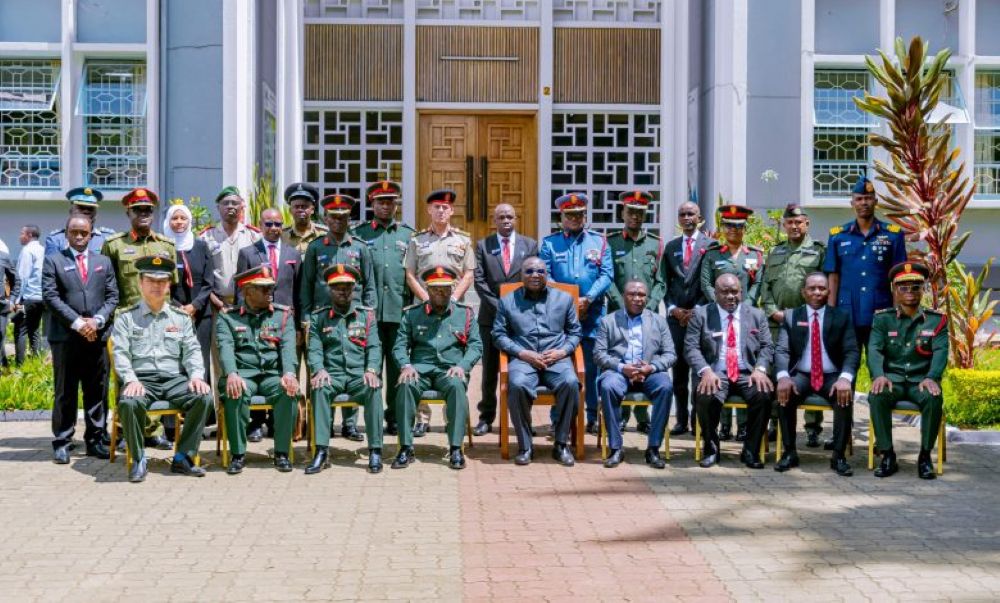
Over 70 senior military and security officers from 17 nations across Africa and Asia are in Tanzania’s tourism capital, Arusha, for a week-long study mission exploring how the tourism sector fuels national security, diplomacy, and sustainable economic growth.
The delegation, hosted by Tanzania’s National Defence College (NDC), began its field tour on November 10 and will wrap up on November 15, 2025. The annual academic visit has become a hallmark of NDC’s long-term strategic studies, designed to connect development priorities with national and regional stability.
Ambassador Major General Wilbert Augustine Ibuge, the NDC Commandant, said the team includes senior directing staff and participants of the college’s 14th long course, which runs from September 2025 to July 2026.
He emphasized that the initiative highlights how non-military sectors such as tourism play a critical role in safeguarding national interests.
“Security is not only about the strength of the military. It is also about protecting and empowering the sectors that drive our development. Tourism is one of them, it promotes jobs, foreign exchange, and peace through cooperation,” Ibuge said.
The officers are drawn from Tanzania, Kenya, Uganda, Rwanda, Burundi, Malawi, Namibia, Botswana, Zambia, Zimbabwe, South Africa, Sierra Leone, Ethiopia, India, Egypt, Bangladesh, and Nigeria.
They will visit key tourism and conservation institutions, including the Tanzania National Parks Authority (TANAPA), Ngorongoro Conservation Area Authority, and the East African Community (EAC) headquarters.
Arusha Regional Commissioner Amos Makalla welcomed the delegates, describing the region as “the beating heart of Tanzania’s tourism economy,” home to iconic destinations such as Serengeti and Ngorongoro that continue to attract millions of international visitors annually.
“Arusha is a living model of how peace, security, and tourism are interlinked. We are proud to host our brothers and sisters from across the continent and beyond in a city that stands as a symbol of regional cooperation and stability,” Makalla said.
Colonel Bhekisile Audrey Mathonsi from South Africa, who spoke on behalf of the visiting team, noted that the study tour is a platform to exchange ideas on how tourism can serve as a soft-power tool for diplomacy and economic resilience.
Tourism is one of Africa’s fastest-recovering industries post-pandemic, contributing nearly 9% of the continent’s GDP in 2024, according to the African Development Bank.
For Tanzania, where natural attractions like Mount Kilimanjaro, Serengeti, and Zanzibar define global travel dreams, the sector remains a strategic pillar of both economic progress and regional cooperation.
