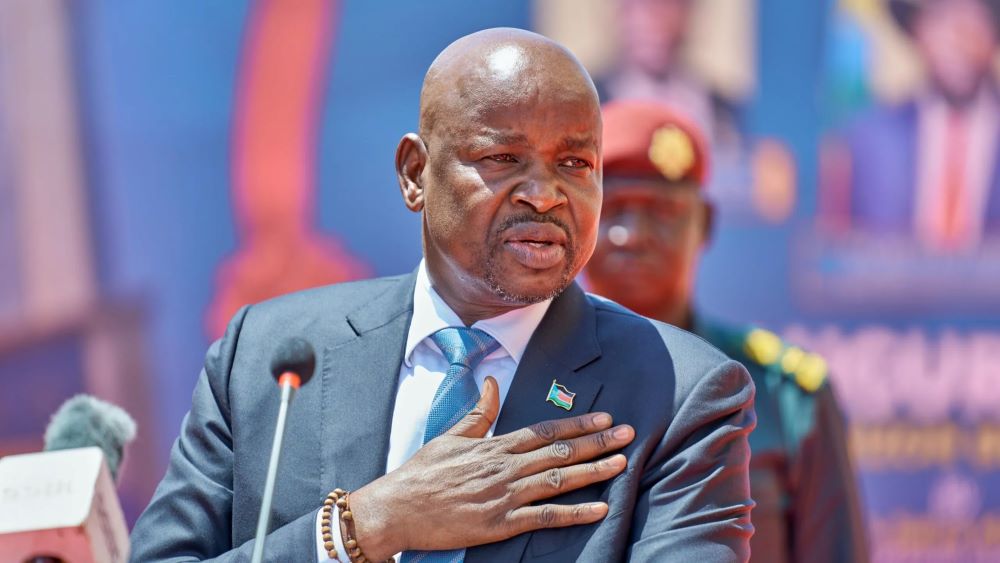
In an unprecedented political shake-up, South Sudan’s President Salva Kiir has removed Dr. Benjamin Bol Mel from his post as Vice President, demoted him from military general to a private, and placed him under house arrest in Juba.
The move, announced via a presidential decree broadcast on state television, also stripped Bol Mel of his leadership role in the Sudan People’s Liberation Movement (SPLM).
Bol Mel responded with measured gratitude. In a post on X, he thanked Kiir for the “privilege to serve” as Vice President and First Deputy Chair of the SPLM, describing the role as “among the greatest honours” of his life.
He highlighted his contributions to the economy, citing efforts to attract private-sector investment, improve non-oil revenue systems, and strengthen financial transparency, achievements he attributed to Kiir’s “steady leadership.”
Analysts say the purge points to deepening internal tensions in Kiir’s government. Bol Mel, once viewed as Kiir’s potential successor, rose rapidly: he was appointed Vice President in February, named First Deputy Chair of the SPLM in May, and promoted to full general in September.
His ascent had raised eyebrows, and his swift fall now fuels speculation about a consolidation of power by Kiir. The dismissal came without a public explanation, but it coincides with serious allegations of corruption.
Bol Mel has been under U.S. sanctions since 2017 over accusations of financial misconduct. A recent U.N. report added weight to those concerns, alleging that companies linked to him received $1.7 billion for road construction contracts that were never completed.
Further indicating a broader realignment, Kiir’s decree also removed several officials seen as Bol Mel allies: the governor of the central bank, the head of the revenue authority, and key SPLM figures were all dismissed.
Eyewitnesses say Bol Mel’s home was surrounded by security agents soon after the decree. His personal guards were withdrawn, their places taken by new personnel, and his access to the outside world was curtailed.

Kiir has dismissed more than 37 senior officials in under a year, a trend viewed by some as his effort to neutralize rivals ahead of future political contests. These events unfold against a backdrop of fragile stability.
South Sudan’s 2018 peace deal has long been tested by accusations of corruption, ethnically charged power struggles, and stalled reforms.
Journalists and analysts warn that removing such a high-profile figure as Bol Mel, once a symbol of economic reform, could deepen fissures within the ruling party and resurrect fears of renewed conflict.
Bol Mel’s reaction, however, remained composed. In his public statement, he expressed confidence that Kiir’s leadership would guide South Sudan forward, saying, “As our nation moves forward, I have full confidence that South Sudan and the SPLM will continue to rise under your stewardship.”
His fall from grace comes at a fraught moment for South Sudan. The country has repeatedly postponed elections, and internal divisions within the SPLM, once the backbone of South Sudan’s independence, now threaten to unravel the very power-sharing arrangements that ended its civil war.
Whether Bol Mel’s removal will stabilize or destabilize Kiir’s rule remains to be seen, but it is undeniably one of the most consequential political purges in Juba in recent memory.
