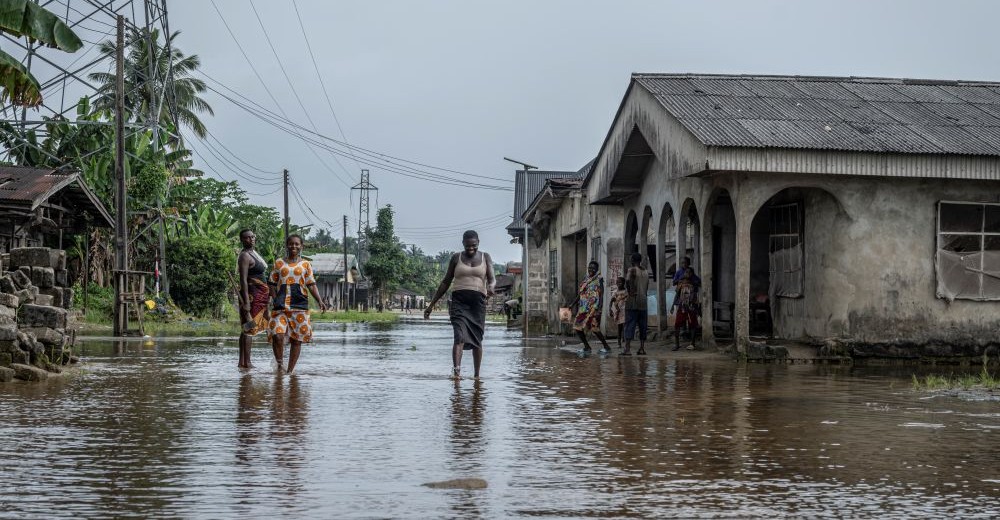
As the world gears up to convene in Belém, Brazil for COP30 from 10–21 November 2025, frontline communities and climate justice advocates insist that the planet cannot wait, and the transition to a greener economy cannot leave workers, women and vulnerable communities behind.
A new report by ActionAid International, shows that only 2.8 per cent of multilateral climate finance supports just-transition approaches that seek to safeguard livelihoods, gender equity and community rights as the world shifts away from fossil fuels and industrial agriculture.
The report, titled Climate Finance for Just Transition: How the Finance Flows, finds that just one US dollar in every 35 of climate-related spending goes towards truly inclusive transitions.
“Our new report shows just-transition approaches are jaw-droppingly under-funded, and people’s needs are at the bottom of the priority list. If just transition continues to be overlooked, then there’s a real risk that inequalities will deepen,” said Arthur Larok, Secretary-General of ActionAid International. “Something’s got to give.
In the lead-up to COP30, the 30th meeting of the Parties to the UNFCCC hosted in the Amazon’s doorstep for the first time, the setting could not be more symbolic.
Brazil’s Amazon-region city of Belém has been chosen as host to underline the urgency of tying forest protection, agro-ecology, Indigenous rights and community livelihoods into global climate goals.
Yet the ActionAid analysis makes clear that even as the global community charts ambitious climate commitments, the human dimension is still being treated as an after-thought.
Teresa Anderson, Global Lead on Climate Justice at ActionAid, warned that no one should have to choose between a secure job and a safe planet. Just transition approaches make sure that climate action prioritizes people’s daily needs and doesn’t accidentally push people deeper into poverty.

When green means invisibility
The report digs into the stark reality behind many so-called “green” investments. Over more than a decade, some US$630 million has been identified as supporting just-transition mitigation efforts, a tiny sum when considered in the global scale of climate finance.
Even the two major funds reviewed, the Green Climate Fund (GCF) and the Climate Investment Funds (CIFs), show minimal alignment with justice criteria: only 5.6 per cent of GCF-projects and just 0.4 per cent of CIFs projects meet the thresholds.
COP30 is the moment of opportunity where a just transition away from fossil fuels to renewable energy is inevitable, but the ActionAid data suggests the opportunity is being squandered for those whose lives hang in the balance.
One of the most vivid illustrations comes from a community near Timbiras in Maranhão, Brazil. For generations, local women have broken babassu coconuts to process oil and fibres. Now they are under pressure as the trees fall to make way for expansive corn, soya and cattle operations.
Jessica Siviero, Climate Justice Specialist at ActionAid Brazil, says: “The Amazon forest acts as the lungs of planet Earth, while the Cerrado serves as its veins… COP30 coming to Belém puts the spotlight on industrial agriculture’s role in driving Amazon and Cerrado destruction.”
According to her, it’s time for the world to move away from harmful industrial agriculture, and towards agroecological approaches that feed people and cool the planet. Just transition approaches need to be applied to agriculture as well, she says.

COP30’s chance and risk
With COP30 looming, Brazil has declared its presidency’s objectives as three-fold: strengthen multilateralism, connect the climate regime to people’s real lives and accelerate implementation of the Paris Agreement through structural adjustment across institutions.
Meanwhile the Council of the European Union has called for a clear path from Belém that keeps 1.5 °C within reach, including the tripling of global renewable capacity, doubling energy efficiency improvement rates and phasing out fossil-fuel subsidies.
ActionAid is calling for the establishment of a Belém Action Mechanism (BAM) on just transition, a global framework to ensure coordination, shared learning and funding that reaches the people most affected.
As Teresa emphasizes, this is a critical opportunity for global climate action to evolve for the better. COP30 needs to deliver on a global plan for just transition to support and reassure those on the frontlines, and to unleash the action our planet so urgently needs.
But lurking beneath the summit’s promise are deep-rooted risks such as rising accommodation costs in Belém which threaten to exclude delegations and civil society from meaningful participation. Critics caution that if frontline voices are shut out, COP30 risks being yet another spectacle rather than a turning point.
For Rwanda and other African countries, where renewable-energy expansion offers real hope for jobs and sustainable growth, the call for justice in transition is not abstract. It is urgent.
Ensuring that renewable investments, agro-ecology schemes and community-centred planning are part of the transition, will determine whether the benefits of climate action are widely shared or narrowly captured.
At COP30, the data from ActionAid not only provides a sobering benchmark but it also offers a pathway. If the world acts, and if finance flows at scale with justice at its heart, then the promise of a fairer, greener future may yet be within reach.
Otherwise, the risk is that the next decade of climate action will replicate old patterns under a new banner of “green growth”, rather than deliver real transformation for those who need it most.
