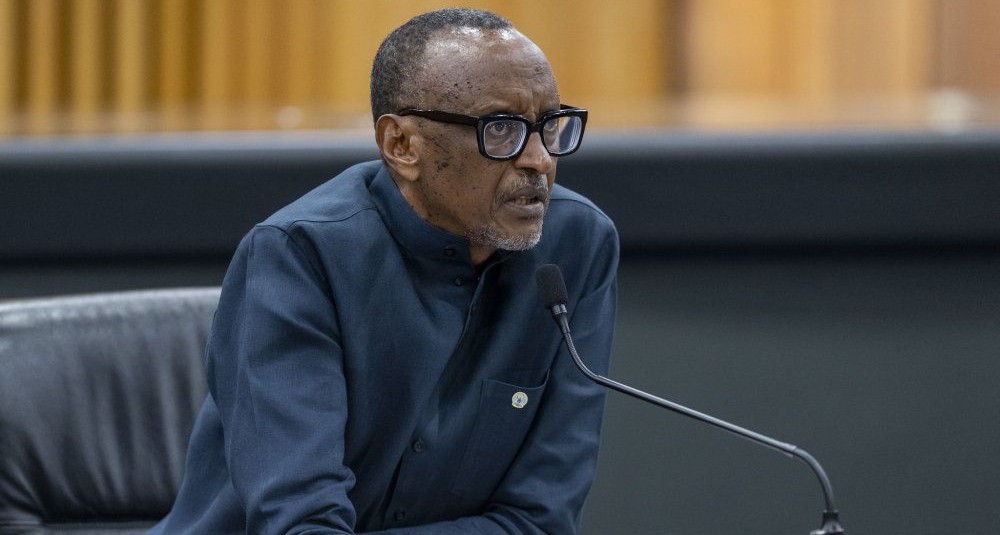
President Paul Kagame has sounded a renewed alarm over what he described as a deliberate effort to revive the Democratic Forces for the Liberation of Rwanda (FDLR), pointing to links between the Habyarimana family, Rwandan fugitives abroad, and senior officials of the DRC.
Addressing journalists on 27 November 2025, he said the resurgence of the group is being enabled by DRC President Félix Tshisekedi and overlooked by European governments that continue to ignore the militia’s deep involvement in regional insecurity.
The remarks came as European states, particularly France, intensify pressure for the reopening of Goma Airport to increase humanitarian access to North and South Kivu. Kagame said the push reflects a selective reading of facts, noting that the DRC itself shut down its airspace and that the FDLR remains entrenched across Eastern Congo.
He argued that discussions about humanitarian corridors cannot be separated from the long-standing political and military support the militia has received from Congolese officials and from a network of European actors who have historically shielded the group from scrutiny.
Kagame revealed that Rwandan authorities have for years monitored a growing alliance between the Habyarimana family and Tshisekedi’s government aimed at strengthening the FDLR. Jean-Luc Habyarimana, son of the former president, has been positioned to take up a leadership role within the restructured militia.
The reorganization strategy, he added, draws together multiple actors including remnants of Kayumba Nyamwasa’s RNC coalition, individuals implicated in the 1994 Genocide against the Tutsi, and supporters of a self-proclaimed “Government in Exile” led by Thomas Nahimana.
“In recent times, whether in years or months, one of Habyarimana’s sons and some fugitives living in Europe and the U.S. have been part of the FDLR agenda. They recruit fighters, provide financial support, and are backed by the President of the DRC himself,” he said.
Rwandan intelligence reports indicate that these individuals have made repeated trips to Kinshasa to coordinate with Congolese leaders known to have collaborated with the FDLR in the past.
Kagame emphasized that this relationship did not emerge suddenly because the DRC has for years provided the militia with weapons, funding, food, and training. He said external actors also play an important role in keeping the group afloat.
“But then you hear some people saying, ‘FDLR? How many are they?’ When we raise concerns about these génocidaires, we are not doing it in hiding. They are being strengthened through their collaboration with Kinshasa or through the open indifference of some European leaders.”
As of mid-2025, estimates placed the FDLR’s manpower between 7,000 and 10,000 fighters. Militarily, it is headed by Pacifique Ntawunguka, known as Gen Omega, while its political wing is led by Lt Gen Victor Byiringiro.
European pressure over Goma airport
Kagame questioned the rationale behind calls to reopen Goma Airport while Eastern Congo’s airspace remains closed. “Planes do not fly in the airspace of Eastern Congo because the DRC government closed its airspace. So how do you reopen an airport in an area where the airspace itself is closed?” he wondered.
European officials have linked the airport’s closure to M23 and its alleged backers, but Kagame argued this ignores the broader landscape of control in the region. He said the FDLR has held sway over large areas far longer than M23 and remains a core actor in the conflict.
“The DRC government and the FDLR control many areas because they were fighting M23 every day even before they reached the airport. Has President Macron ever said anything about the FDLR? Do you know why? There is a long history between the FDLR and those Europeans.”
According to Kagame, this silence is not accidental. “It is those Europeans who control the FDLR. That is why they never say anything about it,” he said, adding that their influence has shaped the narrative on Eastern Congo for decades.
Historical burdens and present-day silence
Kagame linked the reluctance of certain European governments to address the FDLR directly to their historic role in Rwanda’s suffering, including the events that culminated in the 1994 Genocide against the Tutsi.
He warned that efforts to silence Rwanda from discussing this history will not succeed. “If they think they can silence us so that we stop speaking about their role in the grave, historically rooted problems that happened here in Rwanda and that later spread into Congo… that is why no one wants to talk about the FDLR,” he said.
The conflict around Goma, which fell in January 2025 after battles involving FARDC, SADC forces and M23, remains a flashpoint. But Kagame stressed that no meaningful solution can emerge unless the region confronts the FDLR issue openly and without political distortion.
