Kigali, Rwanda – The United Nations has introduced a new open-source modeling tool designed to significantly strengthen how countries plan and implement environmental policies under the Montreal Protocol.
Known as Kigali Sim, the platform gives policymakers advanced analytical capacity to assess greenhouse gas trends, test policy options, and make faster, evidence-based decisions aimed at reducing climate-warming emissions.
The tool was officially debuted during a recent Executive Committee meeting of the Multilateral Fund for the Implementation of the Montreal Protocol.
It was developed by researchers at the University of California, Berkeley, through the Eric and Wendy Schmidt Center for Data Science & Environment (Schmidt DSE), in close partnership with the UN, government experts, and international organizations involved in environmental regulation.
Kigali Sim responds to a growing need within the UN
system for more efficient tools to manage the phase-down of hydrofluorocarbons (HFCs), a group of highly potent greenhouse gases commonly used in refrigeration, air conditioning and food storage.
While HFCs do not damage the ozone layer, they are powerful contributors to global warming if not properly regulated.
The Montreal Protocol, adopted in 1987 and ratified by all UN member states, is widely regarded as the most successful environmental treaty in history. It helped avert a global ozone crisis by controlling ozone-depleting substances.
Since the adoption of the Kigali amendment in 2016, the treaty has expanded its focus to include the phased reduction of HFCs, placing new technical and policy demands on countries, especially developing economies.
To support this transition, the UN’s multilateral fund has already provided more than $4.3 billion to developing countries, known as Article 5 countries, to help reduce HFC consumption and adopt climate-friendly technologies.
However, designing effective national policies has often required complex modeling exercises that are time-consuming and technically demanding.
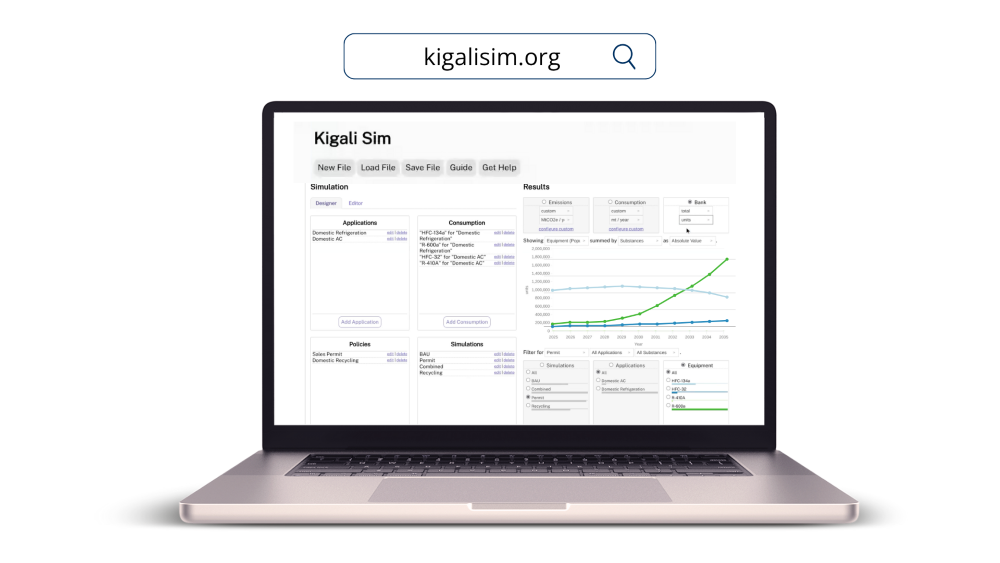
Kigali Sim aims to change that. The platform allows users to input country-level data and simulate different policy scenarios to understand how changes in regulation, technology adoption, or funding allocation could affect emissions, equipment use and consumption trends.
The interface is designed to be accessible to non-programmers, removing a major barrier that has historically limited the use of advanced modeling tools in policy environments.
“Kigali Sim improves global regulation of highly potent greenhouse gases such as hydrofluorocarbons,” said Sam Pottinger, Senior Research Data Scientist at Schmidt DSE and lead developer of the tool.
“It simulates policy outcomes with greater efficiency and ease than previously possible and makes advanced modeling techniques available to decision-makers who do not have technical coding backgrounds,” he added.
One of the platform’s most practical features is its ability to deliver rapid analysis. Users can compare multiple policy options side by side and immediately see projected outcomes.
An optional artificial intelligence assistant helps process data from different formats, explore policy ideas interactively, and interpret results using simple, natural language questions.
According to conservative estimates from the development team, Kigali Sim could help a middle-income country design policies that reduce overall greenhouse gas emissions by about five percent by 2040.
This reduction would represent roughly 10% of that country’s emissions reduction target under the Paris agreement, based on current commitments and projected cooling demand.
These figures do not include additional co-benefits such as energy efficiency gains or reduced pressure on electricity systems.
Balaji Natarajan from the multilateral fund secretariat highlighted the operational impact of the tool. “Kigali Sim offers an opportunity to use advanced data science, including AI, to guide funding and policy implementation under the Montreal Protocol,” he said.
He explained that the level of policy analysis it delivers in a few hours previously required several days of work.
Tina Birmpili, Chief Officer of the multilateral fund, said the tool strengthens the link between scientific research and international decision-making.
“Kigali Sim shows how innovation from academic research centers can directly improve the effectiveness of global environmental governance,” she noted.
During its beta testing phase earlier this year, the platform was used by delegates and experts from more than twelve countries. Their feedback was incorporated to refine the tool and ensure it reflects real-world policy needs.
Participants included representatives from Article 5 countries, donor governments, international agencies, non-governmental organizations and private consultants.
Kigali Sim is free and open-source, can run locally or in a web browser, and allows users to maintain full control over sensitive national data. This design supports transparency while respecting confidentiality concerns that often arise in international policy analysis.

Why it is called Kigali Sim
The tool is named Kigali Sim in reference to the Kigali amendment to the Montreal Protocol, which was adopted in Rwanda’s capital in 2016. The amendment marked a turning point in global climate action by committing countries to phase down HFCs.
By naming the platform Kigali Sim, its developers underscore the tool’s direct role in supporting the implementation of that agreement and honoring the city where the landmark decision was reached.
As countries face increasing pressure to meet climate commitments while sustaining economic growth, Kigali Sim provides the UN and its partners with a practical, data-driven instrument to guide action.
By simplifying complex analysis and accelerating decision-making, the tool is positioned to play a central role in advancing global environmental goals under the Montreal Protocol.