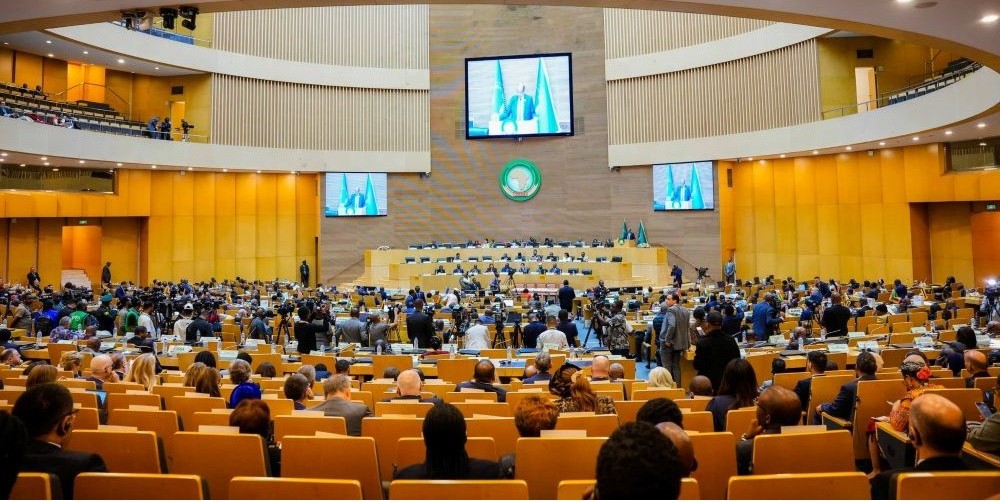
The 48th ordinary session of the Executive Council of the African Union (AU) opened in Addis Ababa with a call for Africa to strengthen its unity, secure sustainable water systems, and build an economic model driven from within if it is to withstand global turbulence and deliver on Agenda 2063.
Ministers of Foreign Affairs from across the continent gathered ahead of the 39th Ordinary Session of the Assembly of Heads of State and Government, under the 2026 theme: “Ensuring Sustainable Water Availability and Safe Sanitation Systems to Achieve the Goals of Agenda 2063.”
For Rwanda, represented by Amb. Olivier Nduhungirehe, the summit comes at a time when water security, regional peace, and economic integration remain central to national and continental priorities.
Water as economic infrastructure, not charity
While water and sanitation have traditionally been framed as social services, speakers at the opening ceremony redefined them as strategic economic infrastructure. Claver Gatete, Executive Secretary of the UN Economic Commission for Africa (UNECA), warned that Africa’s development model must fundamentally change.
“The rules of development are changing. Our development can no longer depend primarily on external conditions. It must increasingly be organized around our own continental economic system,” he said.
Gatete stressed that more than 300 million Africans still lack safe drinking water, while roughly 780 million lack adequate sanitation. The consequences are not only humanitarian but economic.
“When finance is expensive, infrastructure is delayed. When infrastructure is delayed, production is constrained. And when production is constrained, industrialization stalls,” he said.
He described water as a foundational input into production, placed alongside energy, transport and digital connectivity. Without reliable water systems, he noted, industrial parks cannot function competitively and agro-processing cannot scale.
For a country like Rwanda, which is investing heavily in value addition, agro-processing and regional trade under the African Continental Free Trade Area (AfCFTA), the link between water systems and productivity is particularly relevant.
The AU Commission has already declared water security and sanitation “transformational enablers” for sectors such as agriculture, education and industry. Yet financing remains a major obstacle.
Gatete pointed out that Africa’s average tax-to-GDP ratio stands at just 16 percent, compared to 34 percent in the European Union, limiting domestic resource mobilization for critical infrastructure.
Unity in a fragmenting world
Furthermore, the opening ceremony was dominated by concerns over geopolitical shifts, unconstitutional changes of government, and persistent insecurity with Ethiopia’s Foreign Minister, Gedion Timotheos, explaining the stakes.
“African unity must be real and the African Union must be strong if we are to defend our continent from predatory moves that might come from all corners. What we need is not mere charity or goodwill of others, but true partnership,” he said.
He acknowledged progress, including Africa’s common position on UN Security Council reform and climate justice, as well as the readmission of Guinea and Gabon following transitions back to constitutional order. However, he warned that unconstitutional changes of government and growing geopolitical competition undermine stability.
H.E Mahmoud Youssouf, the Chairperson of the African Union Commission admitted that not much progress has been made in resolving some conflicts, highlighting the continued terrorist threats in the Sahel and the Horn of Africa.
The mediation role of the AU in the conflict between the Democratic Republic of Congo and Rwanda was highlighted as part of broader continental peace efforts.
Reforming the union, financing the future
Ambassador Téte António of Angola, Chairperson of the Executive Council, framed the session as a moment of accountability and projection. “This statutory meeting carries particular significance; it represents a crucial moment in our institutional calendar,” he said.
He emphasized the need for a new, fairer scale of member state contributions, calling the current one “completely outdated.” A revised system, based on solidarity, equity and capacity to pay, is expected to strengthen the AU’s financial autonomy and reduce overreliance on external funding.
“The world will not wait for us. Only by upholding these values can we fully defend our collective interests,” António warned.
