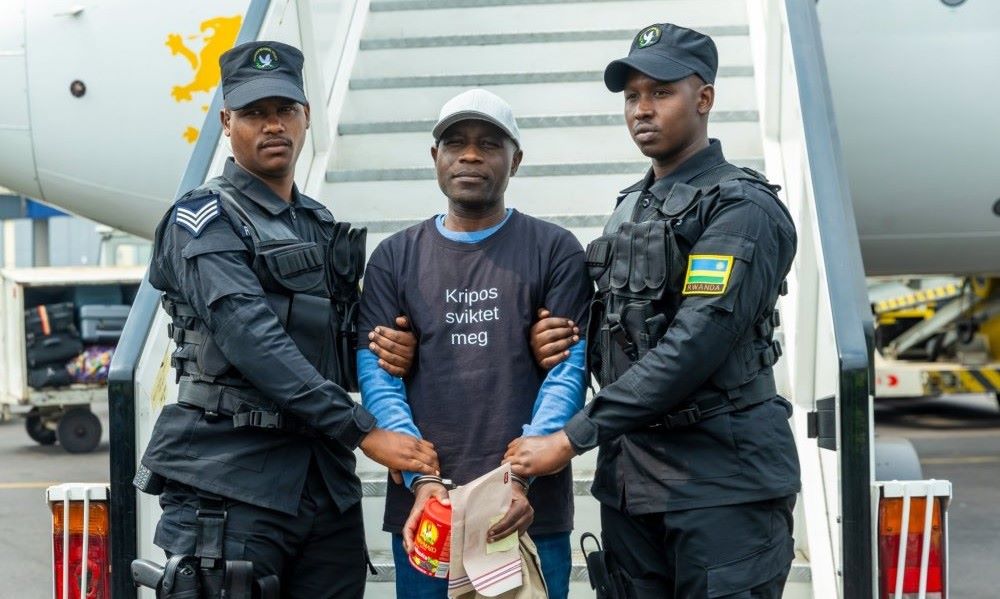
After evading justice for nearly 30 years, François Gasana, a convicted perpetrator of the 1994 Genocide against the Tutsi in Rwanda, has been extradited from Norway to Rwanda, closing a long and arduous legal battle that spanned continents and years.
Known by the alias Franky Dusabe, Gasana’s return to Rwanda on August 8, 2025, under heavy security marked a major milestone in the country’s ongoing pursuit of justice for victims of one of the darkest chapters in modern African history.
Gasana’s story is emblematic of the global dimension of post-genocide justice. Born in 1972 in the former Kivumu Commune, now part of Ngororero District, he was a student at Save Secondary School during the Genocide.
Despite his youth at the time, eyewitness accounts and Gacaca court proceedings later identified him as a key participant in violent crimes committed in the Murambi area.
Among the most harrowing testimonies was his direct involvement in the murder of a Tutsi child with a spear, along with encouraging others to kill. In 2007, the Nyange Gacaca Court convicted Gasana in absentia and sentenced him to 19 years in prison for genocide crimes.
For years, he remained beyond the reach of justice, assuming a new identity in Norway and living under the radar. But that concealment came to an end in October 2022 when Norwegian criminal investigators (Kripos), acting on information from Rwandan authorities and working with international legal mechanisms, arrested him in Oslo.
The process of extraditing Gasana was lengthy and fiercely contested. The Oslo District Court first ruled in favor of extradition in September 2023. He appealed the decision, but both the Court of Appeal in April 2024 and later the Supreme Court in June 2024 upheld the order.
Norway’s Ministry of Justice gave the final green light in February 2025, and the Council of Ministers ratified the transfer shortly after.
Gasana’s arrival in Kigali represented a moment of reckoning for many genocide survivors, especially those in Ngororero District, where his crimes were committed. Rwanda’s National Public Prosecution Authority (NPPA) expressed its deep appreciation for the cooperation shown by Norway in this sensitive case.
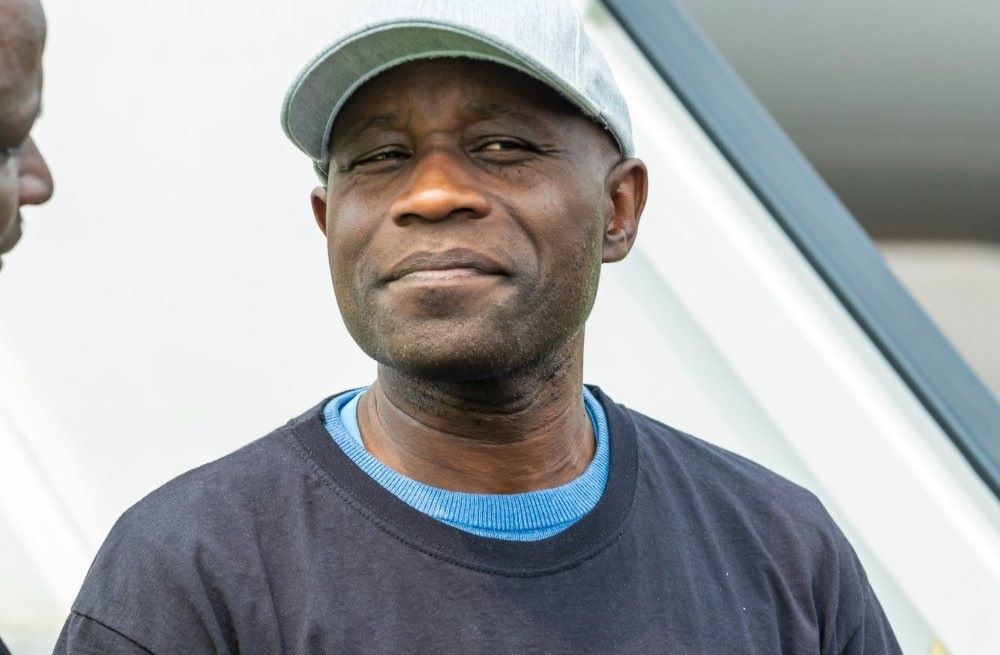
“This is a very commendable act which demonstrates cooperation in justice and Norway’s commitment not to tolerate genocide suspects hiding in their country,” said Faustin Nkusi, spokesperson for the NPPA.
The survivor community also welcomed the move. IBUKA, the umbrella organization for Genocide survivors in Rwanda, described the extradition as a significant win for justice. Dr. Philbert Gakwenzire, the president of IBUKA, praised both the Rwandan justice system and the Norwegian government for their collaboration.
He underlined that it was Rwanda that first identified and tracked the suspect, and it was Norway that honored the extradition request despite legal hurdles.
“Often, these individuals feel safer being far away. It’s very different from returning and facing the people they once tried to kill,” he added.
Gasana had exercised all available legal options to avoid returning to Rwanda, but each attempt to block his extradition failed.
According to legal analysts, this case underscores a shifting trend in international jurisprudence where countries are less inclined to serve as havens for genocide fugitives, regardless of the time passed or the distances involved.
As a convict tried in absentia, Gasana may now request a retrial under Rwanda’s current criminal procedure law. This offers him a chance to contest the original verdict.
Such retrials are not automatic pardons; if new evidence emerges, they could lead to either reduced or harsher sentences.
Prosecutors have already indicated that additional charges may be brought now that Gasana is back on Rwandan soil, suggesting his legal ordeal is far from over.
This extradition is only the second of its kind from Norway to Rwanda, the first being Charles Bandora in 2017, and it may not be the last. Norwegian authorities have confirmed that four other genocide suspects currently residing in the country are under active surveillance.
Rwanda hopes that this latest cooperation signals a renewed commitment by countries worldwide to bring genocide fugitives to account.
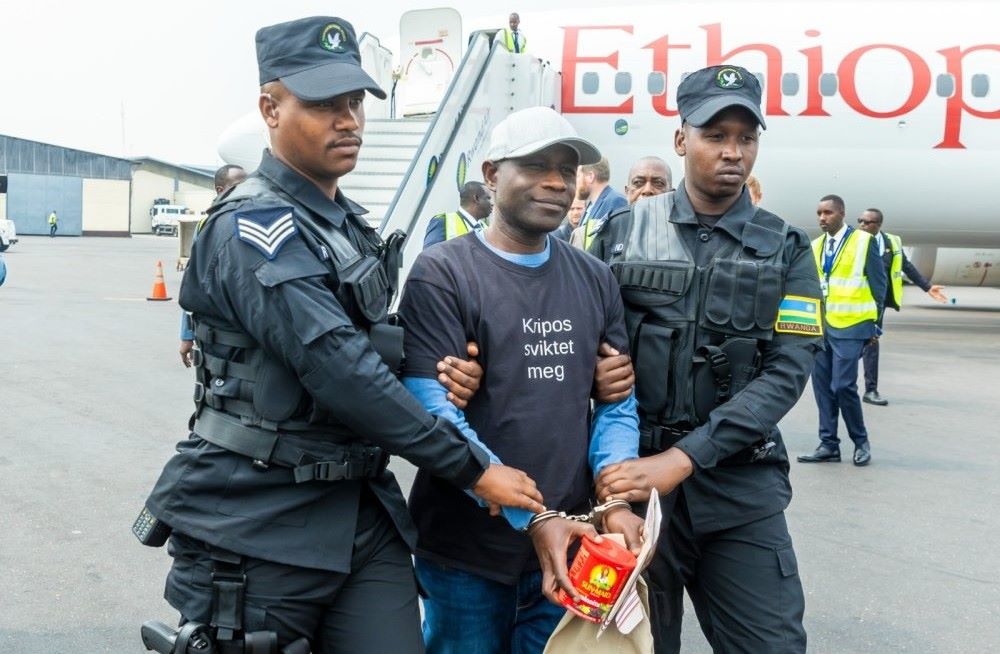
“Countries still hosting genocide suspects should act with urgency, either try them in their own legal systems or extradite them to Rwanda. It’s been 31 years, and something must be done,” Gakwenzire said.
He even proposed the creation of dedicated courts within host countries to handle genocide-related crimes in compliance with United Nations principles on prevention and punishment of genocide.
The extradition of François Gasana is a powerful reminder that justice delayed is not always justice denied.
It is also a clear signal to other fugitives still living under assumed names and false identities that the world is watching, and no amount of time or distance will shield them from accountability.
Rwanda’s unwavering pursuit of justice, combined with growing international support, continues to close the gaps left in the wake of one of the 20th century’s greatest tragedies.
