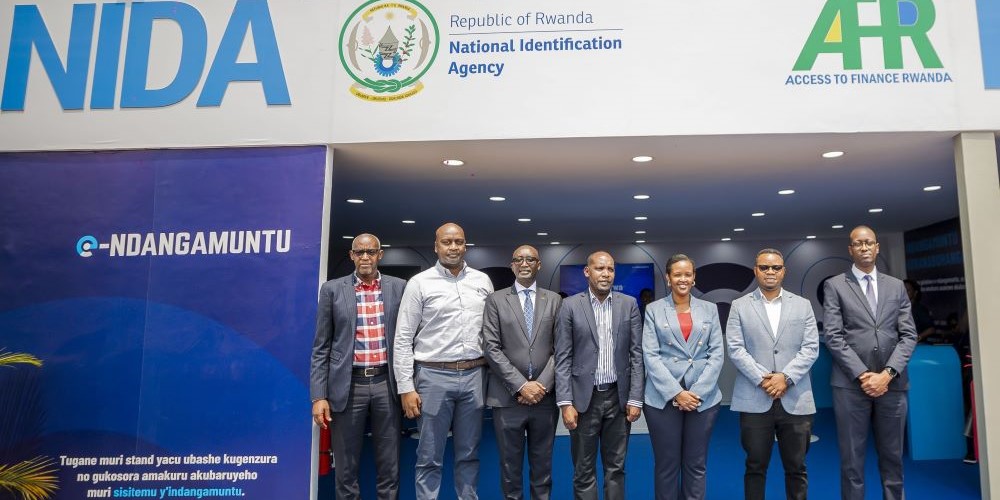
Rwanda has officially launched its new National Digital Identity System (SDID), a groundbreaking shift from traditional card-based identification to a fully digital platform designed to streamline service delivery and reinforce individual data privacy.
The system was unveiled on August 7, 2025, at the ongoing 28th Kigali international trade fair at Expo-grounds, Gikondo led by the National Identification Agency (NIDA) in partnership with the Ministry of ICT and the Ministry of Local Government.
The new system consolidates personal identification data for all people living in Rwanda, including citizens, foreign residents, refugees, asylum seekers, and stateless individuals, into a centralized, secure database.
For the first time, Rwandans will be assigned permanent ID numbers from birth, and those living abroad will also be included in the national ID framework through services offered at Rwandan embassies.
Speaking at the launch, Josephine Mukesha, Director General of NIDA, highlighted that the transition to digital ID is not just a technological upgrade, but a user-focused transformation that prioritizes privacy, control, and accessibility.

“With the digital ID, your personal data will no longer be openly visible as on the current physical ID. Only public details like your photo and names will appear by default, while more private information will only be revealed with your explicit consent,” Mukesha explained.
She noted that the first step in acquiring the digital ID is pre-enrollment, during which individuals verify their information and provide consent for its use as this gives individuals full control over personal information.
“Every time your identity data is accessed to deliver a service, you will be required to confirm and authorize it. You can even choose to revoke consent. It’s a system designed around the user’s control,” she said.
Enrollment will begin at community levels, particularly at village offices and health centers, especially for newborns. Mobile service units will also support outreach, ensuring that even the most remote citizens are covered.
Citizens from the age of five will be required to provide biometric data, iris scans, fingerprints, and a digital photo, while for children under five, only a photo will be required.
A physical card with embedded digital information will be issued to individuals without access to smart devices, ensuring they too can benefit from the system.

Yves Iradukunda, the Permanent Secretary at the Ministry of ICT, described the new system as a pivotal step in Rwanda’s digital transformation journey.
“The digital ID is a platform for secure, transparent, and efficient service delivery across public and private sectors. It will reduce the need for photocopies, eliminate the burden of lost IDs, and allow people to access services from anywhere, at any time,” he said.
“People who previously struggled to access services, such as stateless individuals, abandoned children, and refugees, will now have their data safely stored and accessible for the services they need,” Iradukunda affirmed.
According to sources, a digital verification framework will detect duplicate identities and protect against impersonation, while still allowing legitimate updates for individuals who present legal proof of changes in their personal information.

Bob Gakire, the Permanent Secretary at the Ministry of Local Government, spoke to the relevance of this innovation at the community level.
“Local governments are the first line of interaction between citizens and the state. With this system, we can ensure that services are delivered more efficiently and equitably,” he said.
Once fully operational, service providers across government institutions will integrate the SDID system into their platforms, enabling real-time identity verification using QR codes linked to each individual’s profile.
For minors and vulnerable individuals, access to this information will be strictly controlled by parents or legal guardians.
As Rwanda embraces this digital leap, officials urge all residents, including Rwandans abroad, to engage with the pre-enrollment process and be part of the nationwide shift.
With this move, Rwanda not only reaffirms its commitment to citizen-centric governance but also positions itself among the few countries on the continent spearheading trusted, inclusive, and future-ready identity systems.