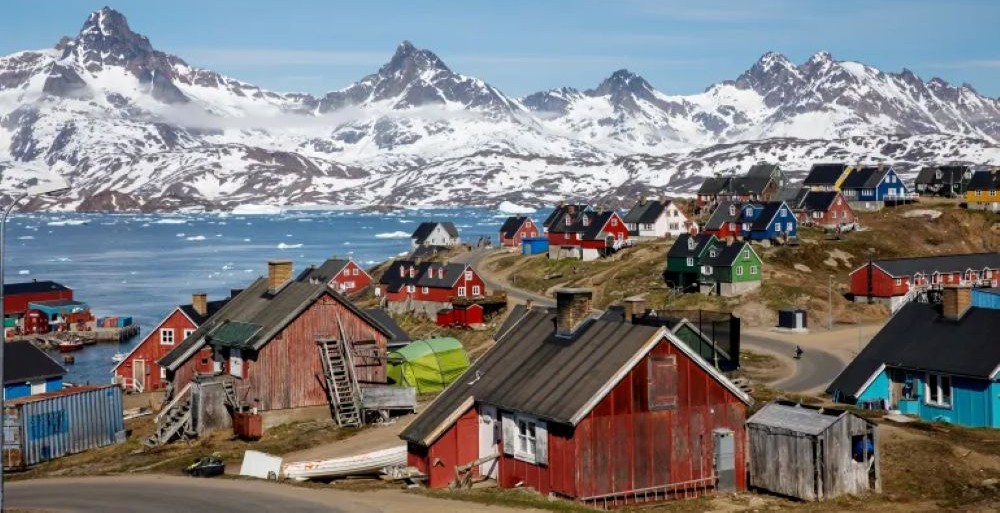
Kigali, Rwanda – Greenland is a land defined by contrasts. Vast, remote, and overwhelmingly frozen, it bears a name that suggests fertility rather than ice. Nearly 80 percent of the island is covered by glaciers, and much of its terrain remains locked in ice year-round.
Yet it is called Greenland, a paradox that has captured attention once more as the island becomes a center of modern geopolitical tension.
What began as a Viking-era marketing trick now intersects with twenty-first-century power politics, demonstrating how names, narratives, and territory shape global ambitions.
The origin of Greenland’s name stretches back over a millennium. During the Viking Age, Scandinavian explorers settled in Iceland and later ventured westward to Greenland.
In the 9th century, Norwegian Vikings were the first to reach the shores of Iceland. It was winter, and as they saw nothing but ice and snow, they naturally named it Iceland,” one historical account notes.
Naming lands based on first impressions was common among explorers, and geographic accuracy often came second to circumstance.
Greenland’s name, however, was deliberate. Erik the Red, exiled from Iceland, sailed west seeking a new settlement. He found an immense island largely covered in ice. Understanding that few would migrate to such a forbidding place, he chose persuasion over precision.
“Realizing that it would be difficult to attract settlers to the island, he used a clever trick and named it Greenland… to make the name sound attractive to new inhabitants,” the historical record explains.
The name was less a reflection of geography than a strategic invitation. That irony, an icy land labeled green, resonates today. Greenland has moved from historical curiosity to strategic prize.

Climate change is melting ice, exposing rare earth minerals, uranium, iron, and potential oil and gas reserves. Its location between North America and the Arctic is critical for missile early-warning systems and monitoring maritime traffic.
It is this strategic value that has renewed interest from the United States. President Donald Trump has repeatedly asserted that the U.S. must “own” Greenland.
“Countries have to have ownership and you defend ownership, you don’t defend leases,” he said, warning that the U.S. would pursue its goal “the easy way” or “the hard way.”
Trump claimed without evidence that Greenland is “covered with Russian and Chinese ships all over the place,” framing it as a frontline in great-power competition.
However, arctic security experts note that while Russian submarines operate in the region, there are no Russian surface vessels in Greenlandic waters, and China’s presence is limited to research ships in the Central Arctic Ocean.
Jess Berthelsen, chair of Greenland’s national trade union SIK, dismissed Trump’s assertions outright:
“We can’t see it, we can’t recognize it and we can’t understand it. The Danish navy is travelling in Greenland waters, and our big trawlers are also everywhere… there’s no such thing,” he said.
The United States already maintains a military presence at the Pituffik Space Base, supporting missile warning, defense, and space surveillance for both Washington and NATO.

Under a 1951 defense agreement with Denmark, U.S. forces can be deployed as needed but analysts argue that Washington already has access to Greenland’s strategic advantages without taking control.
Trump’s rhetoric, however, has unsettled allies. Danish Prime Minister Mette Frederiksen warned that any American takeover would end NATO. “If the United States chooses to attack another NATO country militarily, then everything stops,” she said.
European leaders, including those of France, Germany, Britain, Italy, Spain, Poland, and Canada, have backed Denmark and Greenland, emphasizing that the island’s future must be decided by Greenland and Denmark, respecting sovereignty and territorial integrity.
Political leaders issued a joint statement: “We do not want to be Americans, we do not want to be Danes, we want to be Greenlanders. The future of Greenland must be decided by the Greenlandic people.”
A 2025 public opinion poll found that 84 percent of Greenlanders support independence, while only 6 percent favor U.S. control. The irony is that a land named to attract settlers through optimism is now discussed as a prize to be acquired by global powers.
Analysts warn that any attempt to seize Greenland by force would trigger a NATO crisis and reshape U.S. relations worldwide.
Updated defense agreements, deeper cooperation, and diplomacy could enhance Arctic security without undermining alliances. Greenland and Denmark have signaled willingness to engage, but they reject coercion.
While the ice melts and global interest grows, Greenland is not an empty prize. It is a homeland, with a people determined to shape their own future, in a world that must distinguish between persuasion and possession.

