Every year, the world turns its attention to the 16 days of activism against gender-based violence, a global movement that begins on November 25, the International day for the elimination of violence against women and concludes on December 10, human rights day.
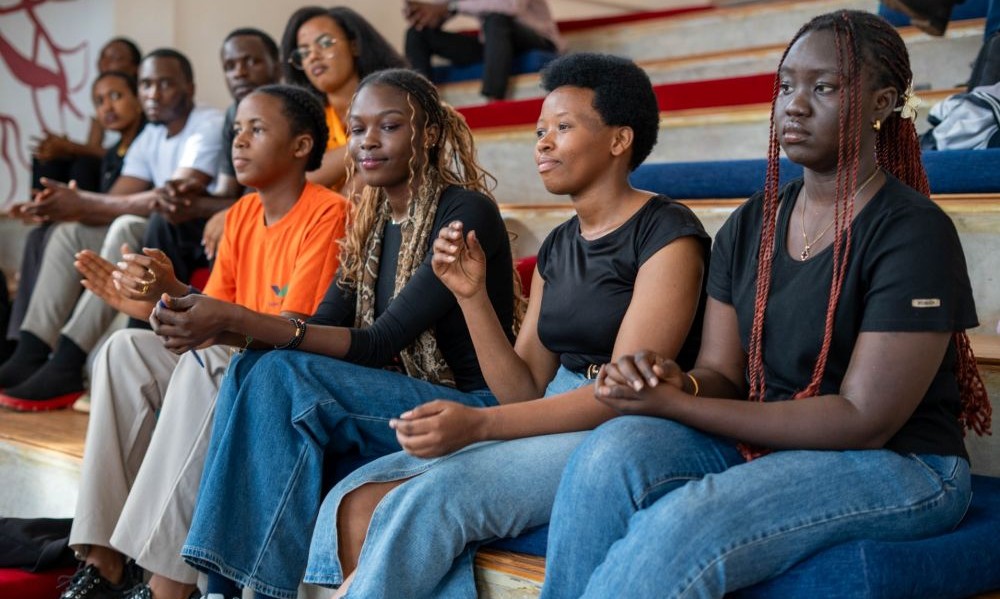
In Kigali, this year’s commemoration took on a powerful and symbolic tone as students from African Leadership University (ALU), Kepler College, East African University and other institutions came together to confront technology-facilitated gender-based violence.
Gathered at ALU’s Kigali campus, young leaders leaned into the global theme, “Unite to end digital violence against all women and girls,” and Rwanda’s national call for “GBV-free families.”
Rahmat Umuhoza, Communications Officer at Rwanda Men’s Resource Centre (RWAMREC) unpacked the increasingly complex world of digital violence highlighting that online harm is not separate from physical abuse but an extension of longstanding gender inequalities
“Technology has amplified the reach of harassment, sextortion, stalking and body shaming. But it has also amplified our ability to respond, to document, to speak out and to stand with survivors,” she explained.
Her message resonated strongly with the young participants who live, study, and socialize within digital spaces every day.

“We cannot innovate in fear. The 16 days’ campaign is not just a tradition, it is a collective responsibility,” said Elizabeth Ndinda, Education Mission Curator at the African Leadership University.
“Rwanda aims to become a regional hub for education and knowledge. That means students must have safe spaces to think, create, and use technology. When women and girls are targeted online, we lose half of our talent, half of our creativity and half of our potential,” she added.
Ndinda noted that the focus on digital safety reflects today’s realities. Many students face cyberbullying, stalking, doxing, and sexualized online manipulation. At the same time, they rely on digital tools for learning, employment, networking and entrepreneurship.
Her remarks echoed the concerns highlighted globally by UN Women, which reports that one in three women experiences GBV in their lifetime and that up to 58% of women and girls face digital violence, often with devastating psychological, social and economic consequences.
She offered a call to action that captured the spirit of the day. “We must work together, men and women, to end all forms of violence, including online abuse. The digital world should be a place of opportunity, not intimidation.”

Mitchell Barure, a first-year software engineering student at ALU spoke passionately about why she chose to participate.
“I am a woman. I have a mother and a sister. I cannot stand by and watch people normalize violence Using my voice is the least I can do. Silence only makes the problem grow,” she said.
For her, activism begins with awareness. She encouraged her peers to seek knowledge and share it. “GBV may not touch you directly, but it affects someone you know. When you understand that, you realize your voice matters.”
From Sierra Leone, ALU student Foday Bangura added a regional, brotherly perspective—one grounded in empathy and responsibility.
“Women are our mothers, our sisters, our daughters. When they are unsafe, families break and communities weaken. I advocate because I want to help create a world where no woman lives in fear, online or offline,” he said.
Bangura also acknowledged that while men are often identified as perpetrators, they can and must be part of the solution. “The digital age has created new forms of violence, but it has also created new opportunities for us to defend, support, and stand up for survivors,” he said.
The students recognized that solutions must combine digital literacy, empathy, strong legislation, community support, and the courage to speak up.

The 16 days of activism against gender-based violence is a global campaign that began in 1991, initiated by the Center for Women’s Global Leadership (CWGL). It was created to raise awareness, inspire action, and encourage governments, organizations, and communities around the world to prevent and eliminate all forms of gender-based violence.
Rwanda has an existing legal framework, from cybercrime laws to data privacy protections, though some gaps still exist especially around explicit recognition of technology-facilitated gender-based violence.

