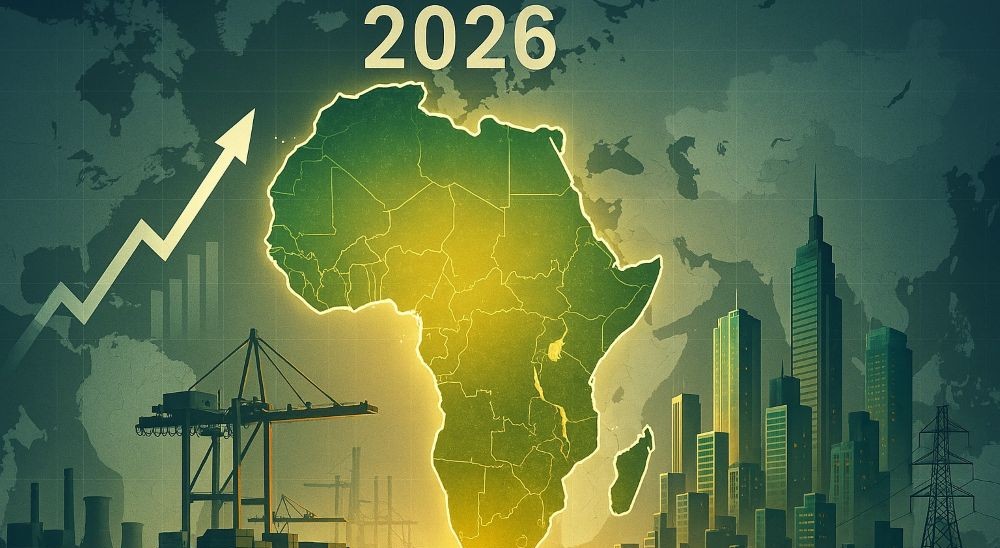
Kigali, Rwanda – Africa is approaching a positive economic phase, with the International Monetary Fund projecting the continent to register some of the world’s fastest growth rates in 2026, even as many advanced economies slow under tight financial conditions and fragile recovery paths.
The IMF’s latest World Economic Outlook places Africa firmly at the forefront of global economic momentum, highlighting a gradual shift in where global growth is generated.
According to the IMF, Africa will host more high-growth economies, defined as expanding by at least six percent, than any other region in 2026.
This performance stands in sharp contrast to the projected global average growth rate of about three percent, which conceals wide disparities between advanced and emerging economies.
While mature economies continue to expand, their progress is increasingly constrained by aging populations, high public debt, elevated interest rates, and slower productivity gains.
The forecast reflects a combination of cyclical recovery and deeper structural changes across the continent. Years of policy reforms, renewed foreign direct investment, and strategic spending on infrastructure, energy, and digital systems are beginning to deliver measurable results.
Although growth remains uneven across countries and regions, the IMF notes that Africa’s long-discussed potential is increasingly being realized in concrete economic performance.
South Sudan and Guinea are projected to lead the expansion, each expected to post double-digit growth in 2026. South Sudan’s outlook is anchored in rising oil production and improved export conditions following years of disruption and macroeconomic stress.
In Guinea, large-scale mining investments, particularly in bauxite, continue to underpin rapid growth, supported by strong global demand and expanding production capacity.
These cases demonstrate how commodity-driven growth, when paired with investment and relative stability, can still generate powerful short-term gains.
East Africa emerges as another major growth pole with Uganda, Rwanda and Ethiopia forecasted to average growth rates of around seven percent, reflecting sustained reform momentum and diversification beyond traditional sectors.
Public investment in transport, energy, and social services, combined with efforts to strengthen domestic revenue mobilization and attract private capital, has helped build more resilient growth foundations.
Their outlook builds on trends observed in 2025, when countries such as Senegal and Niger crossed growth levels considered critical for job creation and poverty reduction. Zimbabwe was projected to be Southern Africa’s best performing economy in 2025.

Africa’s rise amid shifting global growth patterns
From a global perspective, the IMF expects 2026 to be marked by diverging growth paths. U.S. growth is expected to remain around 1.5 to 2 percent, while the Eurozone continues to face energy transition costs, weak industrial output, and geopolitical tensions.
Other advanced economies are projected to grow modestly, constrained by demographic pressures, high debt levels, and lingering effects of tight monetary policy.
In contrast, emerging and developing economies are set to dominate global growth rankings. Africa is expected to concentrate the largest share of fast-growing economies, signaling a broader redistribution of global economic dynamism.
Outside the continent, Guyana stands out as an exceptional case, with the IMF projecting it to remain the world’s fastest-growing economy in 2026 due to rapid expansion in offshore oil production.

Risks, debt pressures, and the test of sustainability
Despite the strong outlook, the IMF cautions that Africa’s growth trajectory faces significant headwinds.
Climate-related shocks remain a persistent threat, particularly for economies reliant on rain-fed agriculture, while political instability in some regions continues to disrupt production and investment. Most immediate, however, is the burden of public debt.
African countries are expected to pay nearly 95 billion dollars to creditors in 2026, straining public finances and limiting fiscal space for development priorities.
In Kenya, for example, debt servicing absorbs roughly a fifth of total government expenditure. Energy access also remains a critical bottleneck, especially in Central Africa, where unreliable electricity supply continues to undermine industrialization and private sector growth.
Alongside these challenges, broader reforms point to a gradual strengthening of Africa’s economic architecture. Financial regulation is tightening, digital transformation is accelerating, and continental initiatives are aligning growth with long-term development goals.
Overall, the IMF’s projections suggest that 2026 could mark a turning point, with Africa’s challenge being to convert rapid growth into inclusive, resilient, and sustainable development.
