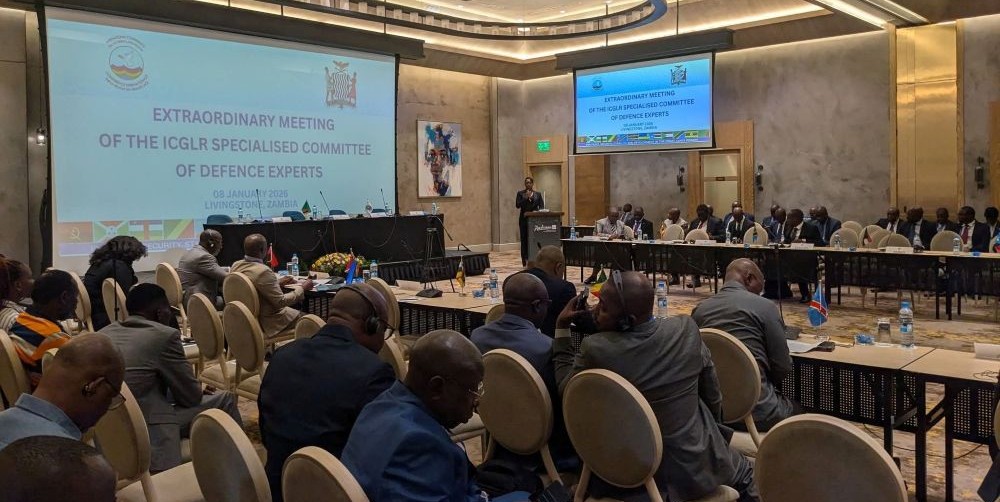
Kigali, Rwanda – Senior defence officials from the International Conference of the Great Lakes Region (ICGLR) convened in Livingstone, Zambia, this week amid growing concern over the deteriorating security and humanitarian situation in the eastern Democratic Republic of the Congo (DRC).
The high-level engagements brought together defence experts, military chiefs, and ministers from ICGLR member states to try and find solutions to a crisis increasingly seen as a threat to regional stability.
Rwanda was represented by the Minister of Defence, Hon. Juvenal Marizamunda at the discussions which underscored the urgency of forging a coordinated regional response as violence, displacement, and insecurity persist despite recent diplomatic initiatives.
The ministerial meeting held on Saturday followed a carefully sequenced process that began with the Extraordinary Meeting of the ICGLR Specialised Committee of Defence Experts on 8 January 2026.
This was followed by the Extraordinary Meeting of the Chiefs of Defence Staff/Forces (CDS/F) on 9 January 2026 in a structured approach reflecting the bloc’s intention to align technical assessments, military strategies, and political decisions into a unified framework.
Participants focused on the worsening security environment marked by the continued presence and activity of armed groups, which have disrupted civilian life and undermined peace efforts.
The humanitarian impact remains severe, with families displaced, livelihoods destroyed, and communities living under constant threat. Regional leaders warned that without decisive and collective action, the crisis risks spilling across borders and destabilizing neighboring countries.
Opening the defence experts’ meeting, Zambia Army Commander Geoffrey Zyeele stressed that the scale and persistence of insecurity in eastern DRC demand stronger cooperation among member states.
He called for enhanced information sharing, deeper trust, and coordinated cross-border operations to confront armed groups that continue to challenge peace in the Great Lakes Region.
“Only through unity of purpose and decisive action can we overcome these destabilizing forces and secure a future of lasting stability,” Zyeele said.

ICGLR Deputy Executive Secretary Yasir Ibrahim Ali Mohammed echoed these concerns, noting that the humanitarian and security situation has deteriorated significantly, posing risks to the sovereignty and territorial integrity of member states.
He observed that the crisis has intensified despite the signing of the Washington Agreements last month, which were meant to reaffirm commitments to peace, security, and regional cooperation.
This underscores the urgent need for all parties to respect their engagements and honor the commitments they have made under regional and international agreements,” he said.
From technical deliberations to political commitment
Key agenda items across the meetings included the Expanded Joint Verification Mechanism Plus (EJVM+), the terms of reference for a ceasefire, and the oversight and monitoring mechanisms agreed upon in Doha.
These tools are seen as central to restoring confidence, verifying compliance, and preventing further escalation. For Rwanda and other ICGLR members, the Livingstone meetings represented more than routine diplomacy.
With a fresh political will to confront a crisis that has defied simple solutions and highlighted the interconnected nature of security in the region, the emphasized collective responsibility, sustained dialogue, and coordinated action look to be the only viable path toward lasting peace in eastern DRC.
