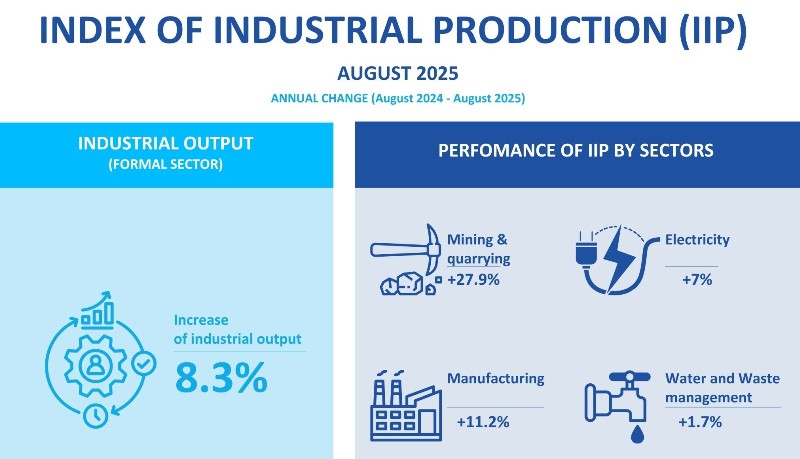
Kigali, October 2025 — Rwanda’s industrial sector continues to show strong signs of resilience and expansion, with formal sector industrial output rising by 8.3% in August 2025 compared to the same month in 2024.
According to the latest data from the National Institute of Statistics of Rwanda (NISR), the annual average growth rate of industrial production now stands at 6.8%.
The August surge was driven largely by exceptional performances in mining and manufacturing activities.
According to the NISR released data, mining and quarrying recorded a remarkable 27.9% increase, underscoring the sector’s growing contribution to Rwanda’s economy.
The spike reflects increased exploration activities, improved operational efficiency, and stronger international demand for Rwanda’s mineral exports such as tin, tungsten, tantalum, and gold.
Manufacturing followed closely, expanding by 11.2%. Within this category, production of non-metallic mineral products, metal products, and machinery registered the highest increases — aligning with Rwanda’s ongoing infrastructure projects and industrialisation drive.
Meanwhile, electricity production increased by 7.0%, reflecting improved access to and reliability of the power supply. Water supply and waste management activities grew modestly by 1.7%, indicating stable performance in essential public utilities.
Implications for economic growth
The continued expansion of Rwanda’s industrial sector highlights the country’s progress toward achieving its Vision 2050 goals — particularly its aim of transitioning from an agriculture-based to a knowledge and industry-driven economy.
Analysts say the robust growth in mining and manufacturing demonstrates that government efforts to attract investment, improve energy access, and expand industrial parks are beginning to pay off.
However, they also note that sustaining this growth will require balancing resource extraction with environmental sustainability and diversifying the manufacturing base beyond construction-related materials.
Despite the encouraging figures, some sub-sectors — notably food processing — continue to face challenges such as high input costs and competition from imported goods.
Experts suggest that addressing logistical bottlenecks, improving access to finance, and strengthening value chains will be key to achieving more balanced growth.
With the mining boom showing no signs of slowing and manufacturing activity accelerating, Rwanda’s industrial sector appears well-positioned to maintain its upward trajectory into 2026.
However, continued investment in skills, technology, and innovation will be essential to transform this growth into long-term competitiveness.
