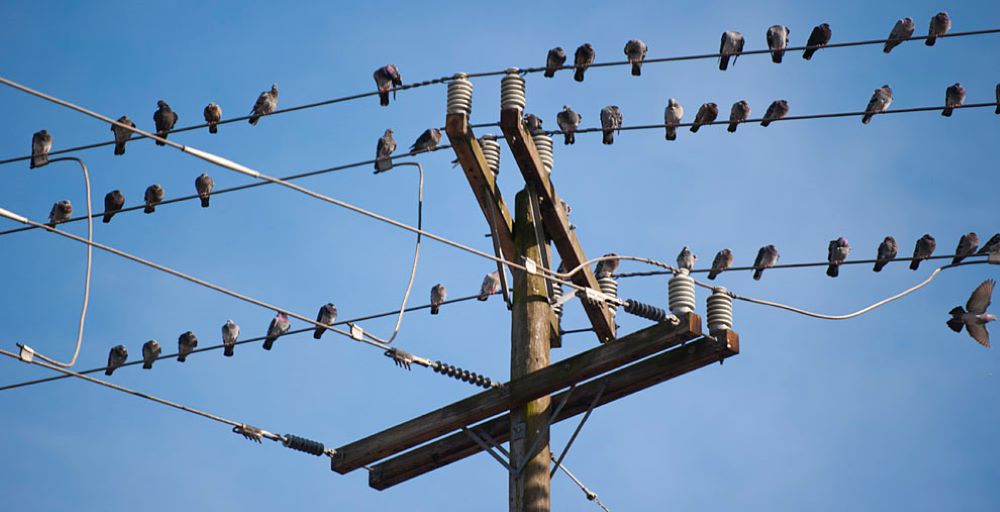
It is a scene so familiar that we rarely stop to think about it, flocks of birds balancing effortlessly on high-voltage power lines, seemingly untouched by the deadly electricity running beneath their feet.
To many, it feels almost like magic. Since childhood, we have been warned about the dangers of electricity, yet these creatures perch calmly on wires that could kill a human in seconds.
The reason birds survive is found in a fascinating combination of physics and biology. Electricity always moves along a path from a point of high electrical potential (voltage) to a point of lower potential, usually toward the ground.
For current to flow through a body, whether bird or human, there must be a difference in voltage between two points it touches. Without this difference, the electrical current has no incentive to pass through.
When a bird lands on a single power line, both of its feet are in contact with the same electrical potential. This means the voltage is equal at both points of contact, leaving no significant difference for current to travel through its body.
In other words, the bird is not completing a circuit. Its small size, the close spacing of its feet, and its isolation from the ground all work together to keep it safe.
Humans face a different danger. If a person touches a high-voltage line while standing on the ground, or while touching something connected to the ground, the voltage difference between the wire and the ground becomes enormous.
Electricity rushes through the body, from the higher potential of the wire to the zero potential of the earth. The resulting current can cause severe injury or death almost instantly.
Birds, however, are not invincible. Electrocution occurs when they accidentally create a path for electricity to travel between two different voltage points.
This can happen in several ways. Large birds such as eagles or cranes have wingspans wide enough to touch two power lines at once, especially if those lines carry different voltages. This difference forces current through the bird’s body, often fatally.
Similarly, if a bird touches a wire and a grounded structure, such as a utility pole, metal support, or transformer, at the same time, it becomes part of a circuit. The electricity flows from the wire, through the bird, and into the ground.
In some cases, birds can bridge the gap between a live wire and grounded equipment, or between two wires carrying electricity in different phases, with the same deadly result.
The calm sight of a bird on a power line hides a delicate balance of conditions that make its safety possible. As long as the bird remains in contact with only one wire and avoids touching anything at a different voltage, it will remain unharmed.
But the instant it bridges that gap, whether through a wingtip, beak, or talon, the invisible force it has been ignoring can prove instantly fatal. What appears to be a casual perch is, in truth, a silent lesson in the rules of electricity.