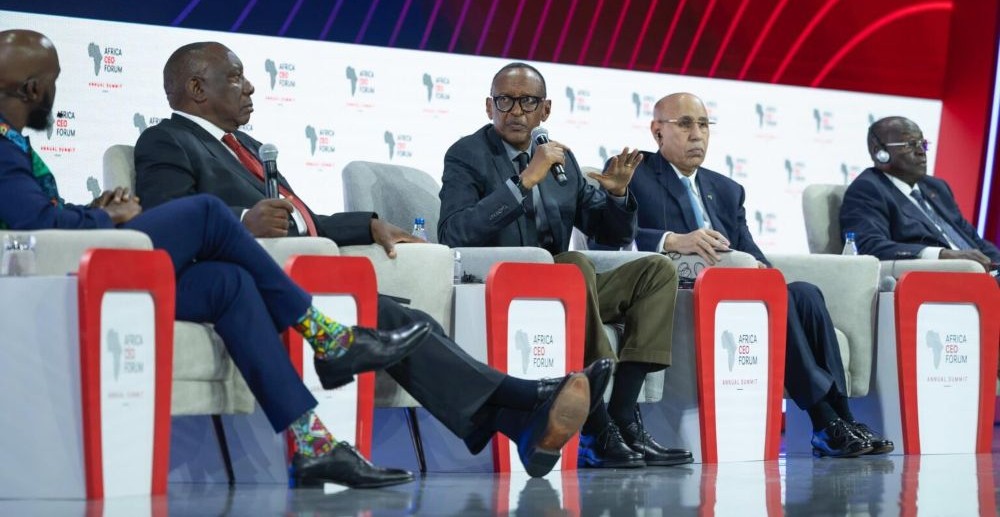
KIGALI – As global trade tensions intensify, aid flows decline and major economies consolidate around industrial power and strategic capital, African leaders are preparing to confront a defining economic question on whether Africa can build economies large enough to compete in an increasingly fragmented world.
That debate will shape discussions at Africa CEO Forum 2026, where more than 2,500 executives, investors, policymakers and heads of state from over 75 countries are expected to gather for one of the continent’s most influential private sector summits on May 14 and 15, 2026.
Held under the theme “Scale or Fail: Why Africa Must Embrace Shared Ownership,” this year’s forum reflects growing recognition that Africa’s economic future may depend less on natural resources and more on its ability to build integrated markets, industrial capacity and African-controlled investment systems.
“In the global competition for capital, size matters,” the forum’s concept paper states, arguing that Africa must move beyond isolated national ambitions and begin building continental champions capable of competing globally. It indicates that in today’s global economy, fragmentation carries a cost.
From Growth Narrative to Industrial Strategy
This year’s program shows a noticeable shift in Africa’s economic conversation from broad development ambitions to harder questions around industrialization, infrastructure, financing and competitiveness.
Several panels will examine whether African economies can transition from commodity dependence to integrated industrial production by linking mining, energy, manufacturing and logistics into scalable regional value chains.
A high-level discussion on the “Mineral-Power Nexus” will explore how mining projects can evolve from isolated extraction sites into industrial ecosystems that support energy generation, mineral processing and regional manufacturing.
Trade and industrial policy are also expected to dominate conversations as African economies face mounting pressure from global manufacturing competition and shifting supply chains.
One executive dialogue titled “Open for Business—or Open Season?” will examine how African industries can remain competitive amid rising overcapacity from Asian manufacturers increasingly targeting African markets.
Technology sovereignty has equally emerged as a central concern.
Panels on artificial intelligence, smart industries and digital infrastructure will question whether Africa can modernize rapidly without surrendering control of critical technologies, industrial systems and strategic data infrastructure to foreign players.
Financing Africa’s Ambitions
A major theme running through the summit is Africa’s struggle to finance large-scale infrastructure and industrial transformation despite the continent’s growing domestic capital base.
African pension funds and institutional investors collectively manage more than $1 trillion in assets, yet infrastructure investment allocations across the continent remain marginal.
Several sessions will therefore focus on whether African capital markets, sovereign institutions and pension funds can begin financing infrastructure, housing and industrial projects traditionally dependent on external lenders and development finance institutions.
Panels on long-term institutional capital and infrastructure financing are expected to examine how African savings can be redirected toward bankable continental projects capable of generating sustainable returns.
Healthcare and logistics are also emerging as strategic business sectors rather than purely social priorities.
Executives from companies such as Zipline are expected to discuss how drone logistics, digital systems and supply-chain innovation are reshaping healthcare delivery while opening new commercial opportunities across underserved markets.
The program further reflects growing recognition that infrastructure, from ports and transport corridors to energy grids and digital networks, has become central to Africa’s competitiveness in global trade.
A Continent Searching for Economic Leverage
The Africa CEO Forum has steadily evolved from a networking platform into a high-level arena for debates about Africa’s long-term economic direction.
Last year’s edition attracted more than 2,800 participants, including senior government officials, multinational corporations, investors and business leaders from over 90 countries, underscoring the forum’s expanding global relevance.
This year’s speaker lineup includes President Paul Kagame, IFC Managing Director Makhtar Diop, Ecobank CEO Jeremy Awori and African Development Bank President Sidi Ould Tah.
Other discussions will focus on sports business, energy transition, startup consolidation, labour mobility and Africa’s expanding digital economy.
But beneath the investment pitches and executive panels lies a deeper concern shaping nearly every session: whether Africa can convert its demographic weight, resource base and growing markets into genuine economic leverage.
The forum’s central concern is that Africa’s challenge is no longer simply attracting investment. It is building economies large enough, connected enough and competitive enough to shape their own place in a rapidly changing global order.
