
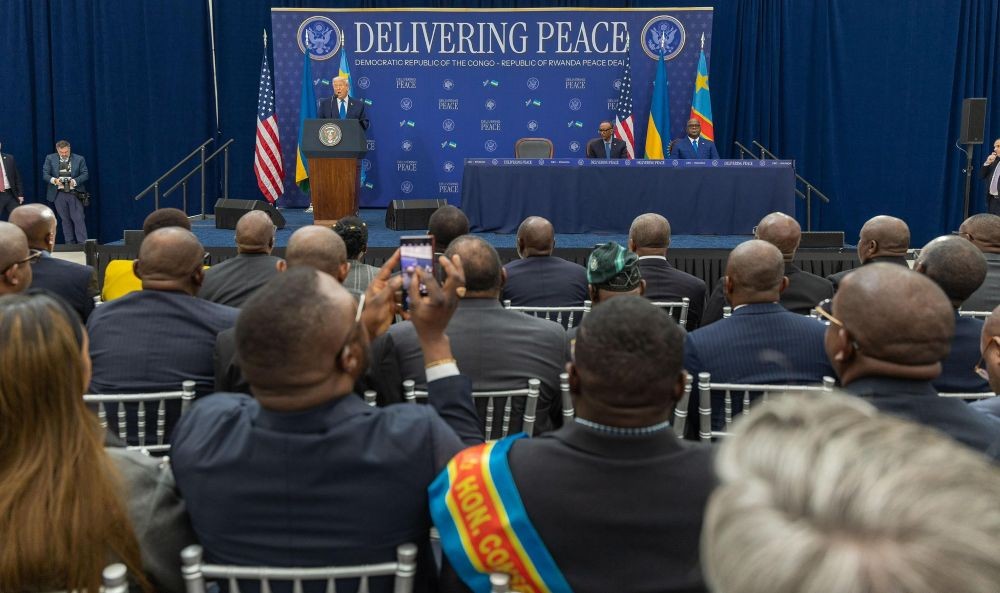
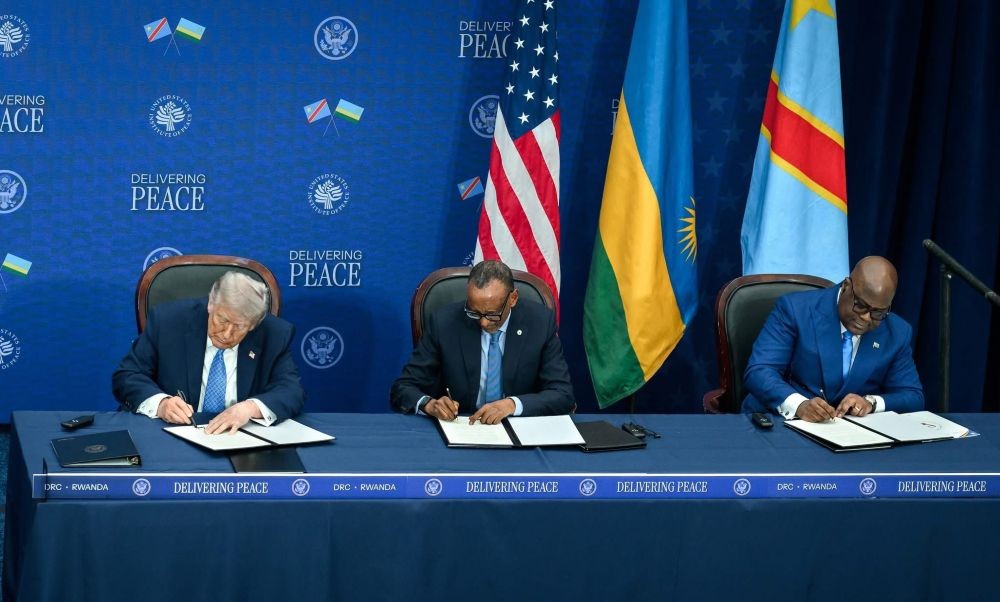
A wave of rare optimism swept through Washington, D.C. as Rwanda and the Democratic Republic of Congo (DRC) signed a historic peace agreement in the presence of African leaders and U.S. President Donald Trump.
The ceremony marked the formal end to more than three decades of conflict that has destabilized the Great Lakes region, derailed economies, and cost millions of lives.
For many African leaders present at the ceremony, it represented a long-awaited turning point, an opportunity to replace distrust with cooperation and unlock the region’s vast economic potential.
What unfolded on stage was a shared sense of relief and renewed hope, as presidents and senior officials praised the agreement as a genuine chance to reset relations between Rwanda and the DRC and to usher in a new era of peace.
Angola: “A conflict that made no sense must now come to an end”
Angolan President João Lourenço, who has long played a mediating role in Great Lakes diplomacy, opened his remarks by underscoring the significance of the moment.
“This conflict lasted more than three decades, far too long for two neighboring nations that should have been building together,” he said, calling the war senseless and devastating both for ordinary citizens and national economies.
Lourenço emphasized that the Great Lakes region is “one of the richest in the world,” endowed with abundant water, fertile land, forests, and minerals. And yet, he said, none of this potential could be developed because the region “remained hostage to endless instability.”
He pointed to the great Inga dam as a symbol of what could be possible if peace holds. “The Inga project could power Africa’s industrialization,” he said, noting that agriculture too could transform the continent thanks to the region’s reliable rainfall.
Although Angola and other African states had worked tirelessly to resolve the crisis, Lourenço stressed that it was the United States, under Trump’s mediation, that finally achieved a breakthrough. “We must thank President Trump for continuing the work we started and for getting us to this outcome.”
But he warned that implementation, not signing, will determine success. “One thing is to sign an agreement. Another, more difficult, is to show political will to implement it. We hope both Rwanda and the DRC will do their part.”
Togo: “The region finally gets a chance to breathe”
Faure Gnassingbé, the President of the Council of Ministers of Togo echoed the significance of the moment, calling the signing “the end of a war that has burdened the region for more than thirty years.”
He emphasized the huge losses borne by the people, economies, and environment of the Great Lakes region. But he also highlighted the emerging opportunities:
“This agreement opens doors for the entire continent. It can help Africa address food insecurity and energy shortages at a time when the world is facing both crises.”
Like Angola, Togo hailed Trump’s role in breaking the diplomatic deadlock, saying: “We thank President Donald Trump for helping reach this milestone.”
He urged Rwanda and the DRC to honour their commitments and “implement this agreement for the benefit of their countries, their peoples, and Africa.”
Kenya: Ruto says peace will unlock Africa’s economic future
Kenyan President William Ruto framed the accord as a turning point for Africa’s development. “What has been achieved here is not only transformative, it is historic,” he said
Ruto praised the combined efforts of the East African Community, SADC, and the Washington process, arguing that the agreement demonstrates the power of coordinated regional diplomacy.
He stressed that ending the conflict in eastern DRC could unlock one of Africa’s greatest economic opportunities. “Our vast resources and our young talent, connected by regional infrastructure and the African Continental Free Trade Area, can ignite unprecedented transformation.”
Ruto argued that peace will drive integration, investment, and industrialization. “For too long, Africa has exported raw materials only to import finished products at high cost. This agreement gives us a chance to build value chains here at home.”
Before concluding, he appealed to Trump to continue supporting peace efforts elsewhere: “As we celebrate this progress, we must not look away from other crises, especially the humanitarian catastrophe in Sudan.”

Burundi: “A time for destruction is ending; a time for hope begins”
Burundian President Évariste Ndayishimiye took a more spiritual tone, describing the day as “a time for hope after a long era of despair.” “There is a time for everything,” he said. “A time for destruction, and a time to build. Today, we are witnessing a great day.”
He called on all parties to honour their commitments: “Committing is one thing; implementing is another.” He emphasized Burundi’s readiness to support regional economic integration and help operationalize cooperation frameworks already in place.
“We hope together to achieve lasting peace and stability across the region,” he said.
As leaders embraced and congratulated one another, the atmosphere was one of cautious optimism. The Washington Accords mark the closest the region has come in decades to securing lasting peace.
Implementation will determine whether this moment becomes history, or merely another missed opportunity. For now, the Great Lakes region stands at the threshold of a new chapter, one shaped not by conflict, but by cooperation.
