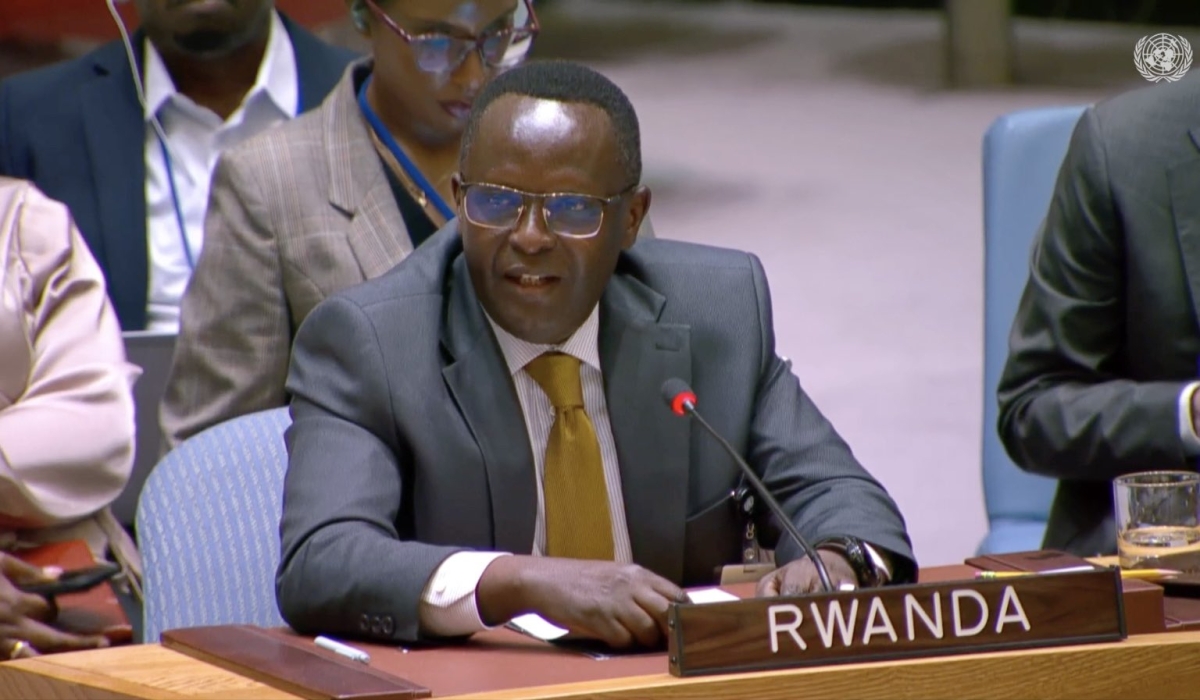
Rwanda’s Permanent Representative to the United Nations, Ambassador Martin Ngoga, has strongly contested recent UN reports accusing Rwanda of involvement in civilian killings in eastern Democratic Republic of Congo (DRC).
Speaking before the UN Security Council on August 22, Ngoga described the allegations as vague, selective, and damaging to efforts aimed at achieving peace in the troubled Great Lakes region.
The controversy stems from a joint report by the Office of the UN High Commissioner for Human Rights (OHCHR) and the UN Joint Human Rights Office (UNJHRO).
Released on August 6, the report alleged that the Armed Forces of Change/M23 (AFC/M23), supposedly backed by Rwanda Defence Forces (RDF), killed 319 civilians and injured 169 more in Rutshuru, North Kivu, between July 9 and 21. The report further claimed that most victims were Hutu farmers.
Ngoga rejected these findings as unsubstantiated, pointing out contradictions in the reporting and questioning the methodology used to determine the victims’ identities and ethnicity.
“Calling for investigation is not too much to ask. Just investigate, or do the minimum, ask those who did the initial report to do a little more,” he said.
“There is no information before the Council of who those victims are. How did you establish their ethnicity? These are basic questions the Council must ask,” Ngoga added.
Warnings against politicized narratives
Ngoga emphasized that portraying victims through an ethnic lens risks fueling further tensions in eastern DRC, where ethnicity has long been manipulated to drive violence.
“The Council is falling into the trap of ethicizing the situation in eastern DR Congo. The reports say the information was obtained via phone and satellite. Was the verification of ethnicity also established by phone and satellite?” he warned.
According to him, the emergence of such reports at politically sensitive moments is not accidental. He linked them to ongoing preparations for peace negotiations in Doha and the implementation of the Washington peace agreement, which calls for the neutralization of the DRC-backed FDLR militia.
“This group remains the principal driver of conflict, violence, and human rights abuses in eastern DR Congo,” Ngoga asserted. “Selective reporting undermines the credibility of UN reports and the pursuit of genuine accountability.”
Ceasefire violations and unanswered questions
Beyond the disputed UN report, Rwanda’s envoy raised alarm over repeated ceasefire violations by Congolese forces and their allies, including Wazalendo militias and the FDLR.
He cited credible intelligence of new military build-ups in Uvira and other areas, questioning Kinshasa’s commitment to peace agreements.
“This issue has been officially raised by Rwanda at this Council and with the Secretary-General on multiple occasions. We remain deeply concerned about what these violations mean in terms of DRC’s good-faith commitment to the peace process,” he said.
Ngoga also criticized the UN’s selective use of language in its reports. He argued that while “Rwanda-backed M23” has become a standard reference, little acknowledgment is given to the FDLR’s long-standing ties to the Congolese government.
“I did not hear a single delegation talk about Kinshasa-backed FDLR. Is it for lack of evidence that this group is backed by the Kinshasa government? Even your own reports contain that evidence. Why not present it for what it is?” he questioned.
Call for accountability and balanced reporting
Ngoga reiterated that Rwanda does not reject scrutiny but insists on fair and fact-based reporting. He urged the UN Security Council to commission impartial investigations and to avoid relying on one-sided narratives that risk inflaming tensions rather than resolving them.
“We are particularly concerned by the longstanding pattern of selective reporting of human rights matters in DR Congo, where victims are portrayed as perpetrators and vice versa,” he said.
He highlighted cases of atrocities overlooked by UN reports, including attacks in Minembwe, South Kivu, Nturo in Masisi, and Ituri, where civilians have suffered drone strikes and arbitrary arrests.
He added that mass detentions based on ethnicity, public humiliation, and dehumanizing rhetoric in schools and places of worship continue to endanger communities in eastern Congo.
The ambassador expressed disappointment that Kinshasa did not agree to launch joint operations against the FDLR during the first meeting of the joint security coordination mechanism on August 7 but maintained that Rwanda is ready to cooperate in good faith.
“Only an impartial and independent investigation can provide the Council with a reliable set of facts to consider. That is the minimum standard if we are to uphold credibility and pursue genuine accountability,” Ngoga insisted.
As tensions persist in eastern Congo, the credibility of international reporting and the willingness of all parties to honor their commitments may determine whether the region moves closer to peace or slips further into mistrust and conflict.
